<?xml version="1.0" encoding="utf-8"?><feed xmlns="http://www.w3.org/2005/Atom" ><generator uri="https://jekyllrb.com/" version="3.10.0">Jekyll</generator><link href="https://georges.fyi/feed.xml" rel="self" type="application/atom+xml" /><link href="https://georges.fyi/" rel="alternate" type="text/html" /><updated>2026-09-17T21:37:05+00:00</updated><id>https://georges.fyi/feed.xml</id><title type="html">Georges Labrèche</title><subtitle>Develops and operationalizes AI technology demonstrators onboard the European Space Agency&apos;s OPS-SAT Space Lab. Edge computing for in-orbit machine learning and autonomous decision-making.</subtitle><author><name>Georges Labrèche</name></author><entry><title type="html">PRETTY DOOMed: The First Voice Command of a Satellite</title><link href="https://georges.fyi/opssat/first-voice-command-of-a-satellite/" rel="alternate" type="text/html" title="PRETTY DOOMed: The First Voice Command of a Satellite" /><published>2026-07-31T00:00:00+00:00</published><updated>2026-07-31T00:00:00+00:00</updated><id>https://georges.fyi/opssat/first-voice-command-of-a-satellite</id><content type="html" xml:base="https://georges.fyi/opssat/first-voice-command-of-a-satellite/"><![CDATA[<p>Hej folks! These past few months I’ve been working on a project to send a voice command to a spacecraft, and I’m happy to say that it finally worked! On 27 July 2026, a radio amateur in Oslo pointed their antenna to space, spoke into a microphone, and a satellite in orbit heard its instructions to play DOOM! It is the <a href="https://tanagraspace.com/opssat-pretty-doomed/">first time a satellite has been commanded by voice</a>.</p>

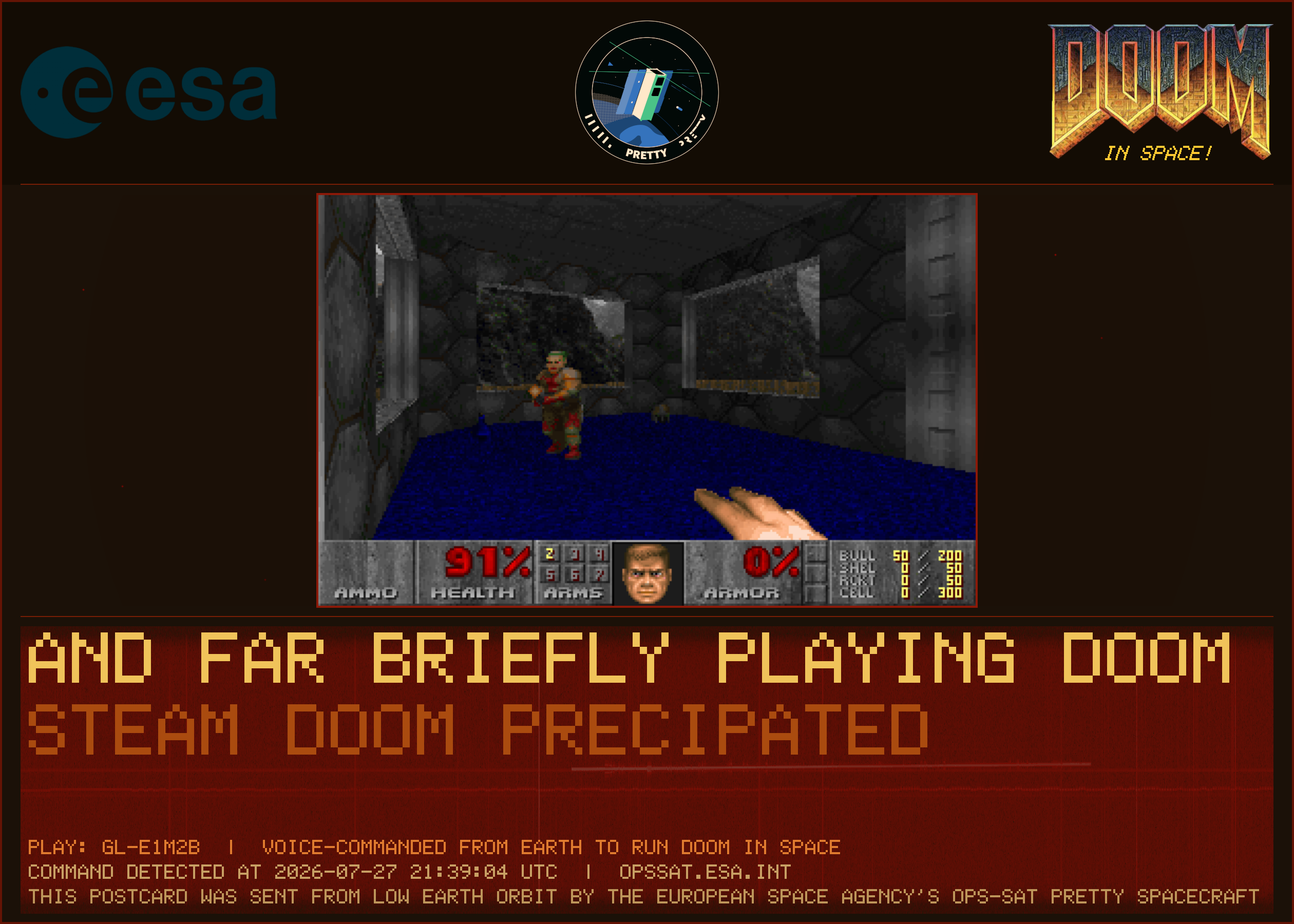
<p>I developed the processing pipeline that ran onboard ESA’s OPS-SAT PRETTY satellite. It captured the 1296 MHz uplink with a software-defined radio, narrowed and demodulated it, transcribed the speech with an onboard speech-to-text AI model, detected the command despite transcription errors, and launched DOOM. It then downlinked a postcard with the gameplay frame, the transcription, and signal diagnostics.</p>

<figure>
  <audio controls="" preload="metadata" style="width: 100%;" src="/assets/images/posts/2026-07-31/command.mp3">Your browser does not support the audio element. <a href="/assets/images/posts/2026-07-31/command.mp3">Download the recording.</a></audio>
  <figcaption>The operator spoke into the microphone: <em>"LIMA ALFA FOUR OSCAR, PRETTY PLAY DOOM DOOM DOOM, PRETTY PLAY DOOM DOOM DOOM."</em> The spacecraft captured this recording during the evening pass.</figcaption>
</figure>

<figure>
  <a href="/assets/images/posts/2026-07-31/postcard-evening.png"><img src="/assets/images/posts/2026-07-31/postcard-evening.png" alt="A DOOM-themed postcard composed onboard the satellite on the evening pass: a gameplay frame with logos, the onboard transcription, and signal diagnostics." /></a>
  <figcaption>OPS-SAT PRETTY composed this postcard and downlinked it, transcription included. That is what the satellite made of the live human voice: imperfect, but the repeated DOOM trigger word still got through.</figcaption>
</figure>

<p>This was not a pre-scripted trigger. It was a spoken command sent over amateur radio, detected and acted on autonomously in orbit.</p>

<p>The Oslo Group of the Norwegian Radio Relay League ran the <a href="https://doom.lb6aj.net">July campaign</a> under the club call sign <a href="https://www.qrz.com/db/LA4O">LA4O</a>: the satellite detected the command from a synthesized voice on the morning pass, then from an operator speaking live into a microphone that evening. The campaign followed earlier link tests from Legnica, Poland. Everyone involved is credited in the <a href="https://github.com/georgeslabreche/opssat-pretty-doomed#acknowledgements">acknowledgements</a>, and the experiment would not have happened without them.</p>

<h3 id="links">Links</h3>

<ul>
  <li><a href="https://tanagraspace.com/opssat-pretty-doomed/">Project Page.</a></li>
  <li><a href="https://github.com/georgeslabreche/opssat-pretty-doomed">GitHub Repository.</a></li>
  <li><a href="https://github.com/georgeslabreche/opssat-pretty-doomed#acknowledgements">Acknowledgements.</a></li>
  <li><a href="https://doom.lb6aj.net">Oslo Campaign Report.</a></li>
</ul>]]></content><author><name>Georges Labrèche</name></author><category term="opssat" /><category term="opssat" /><category term="research" /><category term="doom" /><category term="radio" /><summary type="html"><![CDATA[A radio amateur spoke to a satellite in orbit and it played DOOM.]]></summary></entry><entry><title type="html">CCSDS 124.0-B-1: POCKET+ Compression in Six Languages</title><link href="https://georges.fyi/research/ccsds124-pocket-plus-compression-in-six-languages/" rel="alternate" type="text/html" title="CCSDS 124.0-B-1: POCKET+ Compression in Six Languages" /><published>2026-07-18T00:00:00+00:00</published><updated>2026-07-18T00:00:00+00:00</updated><id>https://georges.fyi/research/ccsds124-pocket-plus-compression-in-six-languages</id><content type="html" xml:base="https://georges.fyi/research/ccsds124-pocket-plus-compression-in-six-languages/"><![CDATA[<p>Hej folks! I developed and released open-source implementations of <a href="https://ccsds.org/Pubs/124x0b1.pdf">CCSDS 124.0-B-1</a>, the lossless compression standard for satellite housekeeping telemetry. They are MIT-licensed and available in six languages: C, C++, Python, Go, Rust, and Java. Check them out at <a href="https://tanagraspace.com/ccsds124/">Tanagra Space</a>.</p>

<h3 id="what-is-ccsds-1240-b-1">What is CCSDS 124.0-B-1?</h3>

<p>Satellites continuously downlink housekeeping telemetry: fixed-length packets of parameters (e.g. temperatures, voltages, and status flags) that barely change from one packet to the next. The standard exploits that redundancy with nothing more than bitwise operations (OR, XOR, and AND), which makes it a good fit for constrained flight processors with real-time demands. It is based on POCKET+, an algorithm designed by the European Space Agency. I wrote about presenting our OPS-SAT-1 implementation at SmallSat 2022 in <a href="/opssat/opssat-leop-commissioning-and-pocket+/">an earlier post</a>.</p>

<h3 id="from-ops-sat-1-to-standard">From OPS-SAT-1 to Standard</h3>

<p>I implemented an earlier version in embedded C for the satellite’s Nanomind 3200 flight computer when I was a spacecraft operations engineer with the European Space Agency’s OPS-SAT-1 mission. We also ran it on the spacecraft’s payload computer. Validating the algorithm and making it flight-proven was quite the adventure that led to its standardization by the Consultative Committee for Space Data Systems (CCSDS):</p>

<blockquote>
  <p>Evans, D., Labrèche, G., Marszk, D., Bammens, S., Hernández-Cabronero, M., Zelenevskiy, V., Shiradhonkar, V., Starcik, M., &amp; Henkel, M. (2022). Implementing the New CCSDS Housekeeping Data Compression Standard 124.0-B-1 (based on POCKET+) on OPS-SAT-1. <em>Proceedings of the 36th Annual Small Satellite Conference</em>. <a href="https://digitalcommons.usu.edu/smallsat/2022/all2022/133/">https://digitalcommons.usu.edu/smallsat/2022/all2022/133/</a></p>
</blockquote>

<p>Releasing these implementations as open source for everyone is a fitting wrap-up to that adventure.</p>

<h3 id="validation">Validation</h3>

<p>Every implementation produces byte-identical output to the ESA reference implementation, passes the UAB/CNES cross-validation suite of 24,900 test vectors, and matches the other five languages bit for bit.</p>

<p>The C implementation is of particular interest for flight software because it is <a href="https://github.com/tanagraspace/ccsds124/tree/main/implementations/c#misra-c2012-compliance">MISRA-C:2012 compliant</a>. MISRA C is the de facto coding standard for safety-critical embedded systems, so the library steers clear of the undefined and error-prone corners of the C language. It is also embedded-friendly by design: C99 standard library only, no dependencies, and static allocation throughout, so no malloc and no free. There are no memory leaks: the test-vector, malformed-input, and robustness suites all pass <a href="https://valgrind.org/">Valgrind</a> checks.</p>

<h3 id="links">Links</h3>

<ul>
  <li><a href="https://tanagraspace.com/ccsds124/">Project Page.</a></li>
  <li><a href="https://github.com/tanagraspace/ccsds124">GitHub Repository.</a></li>
  <li><a href="https://ccsds.org/Pubs/124x0b1.pdf">CCSDS 124.0-B-1 Standard.</a></li>
  <li><a href="https://digitalcommons.usu.edu/smallsat/2022/all2022/133/">SmallSat 2022 Paper.</a></li>
</ul>]]></content><author><name>Georges Labrèche</name></author><category term="research" /><category term="ccsds" /><category term="opssat" /><category term="research" /><category term="compression" /><summary type="html"><![CDATA[Flight-proven on OPS-SAT-1, standardized by CCSDS, and now open-sourced in C, C++, Python, Go, Rust, and Java.]]></summary></entry><entry><title type="html">OPS-SAT DOOM Featured in Nature</title><link href="https://georges.fyi/opssat/opssat-doom-in-nature/" rel="alternate" type="text/html" title="OPS-SAT DOOM Featured in Nature" /><published>2026-03-31T00:00:00+00:00</published><updated>2026-03-31T00:00:00+00:00</updated><id>https://georges.fyi/opssat/opssat-doom-in-nature</id><content type="html" xml:base="https://georges.fyi/opssat/opssat-doom-in-nature/"><![CDATA[<p>The OPS-SAT-1 DOOM experiment is featured in <a href="https://www.nature.com/articles/d41586-026-00813-4"><em>Nature</em></a>! The article explores how DOOM has become a surprising tool for science: from improving AI models and studying the effects of video games on memory, to neurons in a dish learning to play the game, <em>E. coli</em> bacteria displaying its frames, and, of course, running it on a satellite in orbit.</p>

<p>The piece highlights how DOOM’s open-source code and small footprint have made it a go-to platform for creative research across disciplines. Other games like <em>Minecraft</em> and <em>World of Warcraft</em> have also been used in science, but DOOM holds a special place thanks to the “Can it run DOOM?” subculture that keeps pushing researchers and developers to find new and unexpected ways to run the game.</p>

<p>Ólafur and I were interviewed about our OPS-SAT-1 experiment, where we modified DOOM’s code as a fun way as a fun way to experiment with continuous in-orbit regression testing onboard a satellite’s payload computer as well as an experiment sandbox for practical applications of machine learning:</p>

<blockquote>
  <p>“Their experiment showed it was possible to continuously run software tests on a satellite that was in orbit to check whether it still works, a concept that was totally unexplored.”</p>
</blockquote>

<p>I also shared my thoughts on the role of outreach in space science:</p>

<blockquote>
  <p>“Outreach is existential to space agencies, so the headlines and attention we get from saying ‘it runs Doom’ are invaluable.”</p>
</blockquote>

<p>Fieldhouse, Rachel. “<a href="https://www.nature.com/articles/d41586-026-00813-4">How the classic computer game Doom became a tool for science</a>.” <em>Nature</em>, 13 Mar. 2026. doi: <a href="https://doi.org/10.1038/d41586-026-00813-4">10.1038/d41586-026-00813-4</a>.</p>

<p>A big thank you to Rachel Fieldhouse for the interview and resulting article, it was a fun experience. Big kudos to my research partner and co-experimenter Ólafur Waage!</p>

<hr />

<p>Explore <a href="https://github.com/olafurw/opssat-doom">the project on GitHub</a> and, as Ólafur would say, <em>“Never stop learning.”</em></p>]]></content><author><name>Georges Labrèche</name></author><category term="opssat" /><category term="opssat" /><category term="research" /><category term="doom" /><summary type="html"><![CDATA[Interviewed for Nature about how running DOOM on a satellite advances science and public outreach.]]></summary></entry><entry><title type="html">Even More OPS-SAT DOOM Media Coverage</title><link href="https://georges.fyi/opssat/even-more-opssat-doom-media-coverage/" rel="alternate" type="text/html" title="Even More OPS-SAT DOOM Media Coverage" /><published>2025-12-31T00:00:00+00:00</published><updated>2025-12-31T00:00:00+00:00</updated><id>https://georges.fyi/opssat/even-more-opssat-doom-media-coverage</id><content type="html" xml:base="https://georges.fyi/opssat/even-more-opssat-doom-media-coverage/"><![CDATA[<p>It’s the OPS-SAT experiment that keeps on giving. My co-researcher Ólafur Waage followed up on <a href="https://georges.fyi/opssat/opssat-doom-media-coverage/">running DOOM onboard the OPS-SAT satellite</a> with another presentation at Ubuntu Summit 2025:</p>

<!-- Courtesy of embedresponsively.com -->

<div class="responsive-video-container">
    <iframe src="https://www.youtube-nocookie.com/embed/qVrJZiPbQGY" title="YouTube video player" frameborder="0" webkitallowfullscreen="" mozallowfullscreen="" allowfullscreen=""></iframe>
  </div>

<p>This time around we received even more media attention. Here’s a roundup of articles and social media coverage.</p>

<h2 id="articles">Articles</h2>

<p>Zuckerman, Gregory. “<a href="https://www.findarticles.com/doom-runs-on-an-esa-satellite-during-live-orbit-operations/">Doom Runs on an ESA Satellite During Live Orbit Operations</a>.” <em>FindArticles</em>, 26 Oct. 2025.</p>

<p>Vaughan-Nichols, Steven. “<a href="https://www.zdnet.com/article/how-a-programmer-got-doom-to-run-on-a-space-satellite-and-what-happened-next/">How a programmer got Doom to run on a space satellite — and what happened next</a>.” <em>ZDNet</em>, 23 Oct. 2025.</p>

<p>BeauHD. “<a href="https://games.slashdot.org/story/25/10/23/2128244/programmer-gets-doom-running-on-a-space-satellite">Programmer Gets Doom Running On a Space Satellite</a>.” <em>Slashdot</em>, 23 Oct. 2025.</p>

<p>Proven, Liam. “<a href="https://www.theregister.com/2025/10/28/doom_running_in_space/">This is Doom, running headless, on Ubuntu Arm… on a satellite</a>.” <em>The Register</em>, 28 Oct. 2025.</p>

<p>Schestowitz, Rianne. “<a href="http://news.tuxmachines.org/n/2025/10/29/This_is_Doom_running_headless_on_Ubuntu_Arm_on_a_satellite.shtml">This is Doom, running headless, on Ubuntu Arm… on a satellite</a>.” <em>Tux Machines</em>, 29 Oct. 2025.</p>

<p>Wilkins, Joe. “<a href="https://futurism.com/space/hacker-doom-satellite-esa">Hacker Gets ‘Doom’ Running on Satellite in Outer Space</a>.” <em>Futurism</em>, 31 Oct. 2025.</p>

<p>“<a href="https://tech.yahoo.com/science/articles/hacker-gets-doom-running-satellite-160529301.html">Hacker Gets “Doom” Running on Satellite in Outer Space</a>.” <em>Yahoo Tech</em>, 31 Oct. 2025.</p>

<p>Marshall, John. “<a href="https://www.webpronews.com/icelandic-developer-runs-doom-on-esas-ops-sat-satellite/">Icelandic Developer Runs Doom on ESA’s OPS-SAT Satellite</a>.” <em>WebProNews</em>, 31 Oct. 2025.</p>

<p>Jeffrey, Cal. “<a href="https://www.techspot.com/news/110115-enterprising-experimenters-managed-get-doom-running-orbiting-satellite.html">They got Doom running on a satellite orbiting Earth, because of course they did</a>.” <em>TechSpot</em>, Oct. 2025.</p>

<p>“<a href="https://www.news9live.com/technology/gaming/doom-reaches-space-classic-game-on-esa-satellite-2901594">Doom on a satellite? Classic shooter now running on European space satellite</a>.” <em>News9live</em>, Oct. 2025.</p>

<p>Hrinko, Ivan. “<a href="https://universemagazine.com/en/esa-engineers-used-the-op-sat-satellite-to-play-doom/">ESA engineers used the OP-SAT satellite to play Doom</a>.” <em>Universe Magazine</em>, Oct. 2025.</p>

<p>Ferreira, Bruno. “<a href="https://www.tomshardware.com/video-games/doom-can-run-just-about-anywhere-including-space-hacker-recounts-tale-of-running-the-game-on-an-orbiting-satellite">Doom can run just about anywhere, including space — Hacker recounts tale of running the game on an orbiting satellite</a>.” <em>Tom’s Hardware</em>, 1 Nov. 2025.</p>

<p>Jackson, Claire. “<a href="https://kotaku.com/doom-port-runs-on-satellite-esa-op-sat-ubuntu-2000640805">Some Super Clever Folks Got Doom Running On A Goddamn Satellite</a>.” <em>Kotaku</em>, 3 Nov. 2025.</p>

<p>“<a href="https://blog.adafruit.com/2025/11/03/doom-on-a-satellite/">DOOM on a Satellite</a>.” <em>Adafruit Blog</em>, 3 Nov. 2025.</p>

<p>Frank, Edward. “<a href="https://www.gadgetvoize.com/2025/11/03/classic-game-goes-orbital-doom-runs-on-ops%E2%80%91sat-a-satellite-of-european-space-agency/">Classic Game Goes Orbital: DOOM Runs on OPS-SAT, a Satellite of European Space Agency</a>.” <em>Gadget Voize</em>, 3 Nov. 2025.</p>

<p>Sattler, Valentin. “<a href="https://www.pcgameshardware.de/Doom-Classic-Spiel-55785/News/Retro-Shooter-erstmals-Weltraum-ESA-Satellit-1485660/">Doom: Retro-Ego-Shooter lief auf einem ESA-Satelliten</a>.” <em>PC Games Hardware</em>, 3 Nov. 2025.</p>

<p>Evanson, Nick. “<a href="https://www.pcgamer.com/hardware/the-25th-anniversary-of-the-iss-operationally-in-orbit-reminded-me-the-esa-once-challenged-an-assassins-creed-and-far-cry-dev-to-get-doom-running-on-a-satellite/">The 25th anniversary of the ISS operationally in orbit reminded me the ESA once challenged an Assassin’s Creed and Far Cry dev to get DOOM running on a satellite</a>.” <em>PC Gamer</em>, 4 Nov. 2025.</p>

<p>Neviriah. “<a href="https://www.icy-veins.com/other-games/news/doom-runs-on-satellite-using-earth-photos/">DOOM Just Ran in Space, and It Used Real Earth Photos</a>.” <em>Icy Veins</em>, 7 Nov. 2025.</p>

<h2 id="social-media">Social Media</h2>

<blockquote class="instagram-media" data-instgrm-permalink="https://www.instagram.com/reel/DQ6luF2jVkB/" data-instgrm-version="14"></blockquote>
<script async="" src="//www.instagram.com/embed.js"></script>

<blockquote class="instagram-media" data-instgrm-permalink="https://www.instagram.com/reel/DRM_NwXkegz/" data-instgrm-version="14"></blockquote>

<blockquote class="tiktok-embed" cite="https://www.tiktok.com/@thescoreesports/video/7570113874331061522" data-video-id="7570113874331061522" style="max-width: 605px;min-width: 325px;">
  <section></section>
</blockquote>
<script async="" src="https://www.tiktok.com/embed.js"></script>

<!-- Courtesy of embedresponsively.com -->

<div class="responsive-video-container">
    <iframe src="https://www.youtube-nocookie.com/embed/UGXMx6xSVqs" title="YouTube video player" frameborder="0" webkitallowfullscreen="" mozallowfullscreen="" allowfullscreen=""></iframe>
  </div>

<!-- Courtesy of embedresponsively.com -->

<div class="responsive-video-container">
    <iframe src="https://www.youtube-nocookie.com/embed/PC8WiTfLL84" title="YouTube video player" frameborder="0" webkitallowfullscreen="" mozallowfullscreen="" allowfullscreen=""></iframe>
  </div>

<hr />

<p>Explore <a href="https://github.com/olafurw/opssat-doom">the project on GitHub</a> and, as Ólafur would say, <em>“Never stop learning.”</em></p>]]></content><author><name>Georges Labrèche</name></author><category term="opssat" /><category term="opssat" /><category term="research" /><category term="doom" /><summary type="html"><![CDATA[The DOOM port being talked about around the world.]]></summary></entry><entry><title type="html">marsrad v1.0.0: Mars Solar Radiation for R</title><link href="https://georges.fyi/research/marsrad-v1-0-0-mars-solar-radiation-for-r/" rel="alternate" type="text/html" title="marsrad v1.0.0: Mars Solar Radiation for R" /><published>2025-12-01T00:00:00+00:00</published><updated>2025-12-01T00:00:00+00:00</updated><id>https://georges.fyi/research/marsrad-v1-0-0-mars-solar-radiation-for-r</id><content type="html" xml:base="https://georges.fyi/research/marsrad-v1-0-0-mars-solar-radiation-for-r/"><![CDATA[<p>What is marsrad? It stands for “<strong>mars</strong> <strong>rad</strong>iation” and it’s an R package to calculate solar irradiance and insolation on Mars for both horizontal and inclined surfaces.</p>

<p>It took a five-year break to go from research code to a proper release but <a href="https://github.com/georgeslabreche/marsrad">marsrad</a> v1.0.0 is finally <a href="https://CRAN.R-project.org/package=marsrad">available on CRAN</a>. Writing functions is easy, but documenting them and cleaning up the code takes… some motivation.</p>

<h3 id="citation">Citation</h3>

<p>If you use this package in your research or publication, please cite the paper it was developed for:</p>

<blockquote>
  <p>Labrèche, Georges and Cordes, Florian. (2020). <strong>“Using a Rover’s Active Suspension System as a 2-Axis Solar Tracker Mechanism.”</strong> 15th International Symposium on Artificial Intelligence, Robotics and Automation in Space (i-SAIRAS ‘20), October 2020. <a href="https://www.hou.usra.edu/meetings/isairas2020fullpapers/pdf/5035.pdf">https://www.hou.usra.edu/meetings/isairas2020fullpapers/pdf/5035.pdf</a></p>
</blockquote>

<p>BibTeX:</p>

<div class="language-bibtex highlighter-rouge"><div class="highlight"><pre class="highlight"><code><span class="nc">@inproceedings</span><span class="p">{</span><span class="nl">Labreche2020_iSAIRAS20_MarsRoverSherpaTT</span><span class="p">,</span>
  <span class="na">title</span><span class="p">=</span><span class="s">{Using a Rover's Active Suspension System as a 2-Axis Solar Tracker Mechanism}</span><span class="p">,</span>
  <span class="na">author</span><span class="p">=</span><span class="s">{Labrèche, Georges and Cordes, Florian}</span><span class="p">,</span>
  <span class="na">booktitle</span><span class="p">=</span><span class="s">{15th International Symposium on Artificial Intelligence, Robotics and Automation in Space (i-SAIRAS '20)}</span><span class="p">,</span>
  <span class="na">month</span><span class="p">=</span><span class="s">{October}</span><span class="p">,</span>
  <span class="na">year</span><span class="p">=</span><span class="s">{2020}</span><span class="p">,</span>
  <span class="na">url</span><span class="p">=</span><span class="s">{https://www.hou.usra.edu/meetings/isairas2020fullpapers/pdf/5035.pdf}</span>
<span class="p">}</span>
</code></pre></div></div>

<h3 id="background">Background</h3>

<p>The marsrad package implements equations from the Appelbaum et al. papers (NASA Technical Memoranda 102299, 103623, 105216, 106321, and 106700), published between 1989 and 1994.</p>

<p>The package is useful for:</p>

<ul>
  <li>Designing solar power systems for Mars missions.</li>
  <li>Mission planning and energy budget analysis.</li>
  <li>Optimizing solar panel orientations for rovers and landers.</li>
  <li>Understanding how Martian atmospheric dust affects solar energy availability.</li>
</ul>

<h3 id="old-school-cool">Old School Cool</h3>

<p>The Appelbaum formulas are based on Viking Lander optical depth measurements from the late 1970s and early 1980s. They’re 36+ years old now and Mars science has moved on. More recent work includes:</p>

<ul>
  <li><a href="https://www.sciencedirect.com/science/article/abs/pii/S0273117723002673">An improved model for available solar energy on Mars: Optimizing solar panel orientation to assess potential spacecraft landing sites</a> (Kerr et al., 2023).</li>
  <li><a href="https://www.swsc-journal.org/articles/swsc/full_html/2015/01/swsc150027/swsc150027.html">A model to calculate solar radiation fluxes on the Martian surface</a> (Vicente-Retortillo et al., 2015).</li>
  <li><a href="https://agupubs.onlinelibrary.wiley.com/doi/full/10.1029/2008GL034956">Fast and accurate estimation of solar irradiance on Martian slopes</a> (Spiga et al., 2008).</li>
</ul>

<p>However, the Appelbaum formulas remain useful for first-order estimates, educational purposes, and quick trade studies. They’re well-documented, easy to understand, analytically tractable, and give you reasonable ballpark figures for solar energy budgets on Mars. Just don’t use them to design your actual flight hardware without consulting more recent atmospheric models.</p>

<h3 id="key-features">Key Features</h3>

<p>The package provides <a href="https://github.com/georgeslabreche/marsrad/blob/master/FUNCTIONS.md">over 30 functions</a> covering:</p>

<ul>
  <li><strong>Irradiance calculations</strong> (instantaneous power in W/m²): global, direct beam, diffuse, and albedo-reflected components.</li>
  <li><strong>Daily insolation</strong> (energy per sol in Wh/m²-day): total solar energy over a full Martian day.</li>
  <li><strong>Custom period insolation</strong>: energy calculations over any specified time range.</li>
  <li><strong>Utility functions</strong>: sunrise/sunset times, optimal tilt angles, polar day/night detection, solar zenith angle, and atmospheric optical depth.</li>
</ul>

<p>All calculations account for Martian atmospheric conditions, including dust opacity, and support various surface orientations and slope angles.</p>

<h3 id="installation">Installation</h3>

<p>Install from CRAN:</p>

<div class="language-r highlighter-rouge"><div class="highlight"><pre class="highlight"><code><span class="n">install.packages</span><span class="p">(</span><span class="s2">"marsrad"</span><span class="p">)</span><span class="w">
</span></code></pre></div></div>

<p>Or install the development version from GitHub:</p>

<div class="language-r highlighter-rouge"><div class="highlight"><pre class="highlight"><code><span class="n">devtools</span><span class="o">::</span><span class="n">install_github</span><span class="p">(</span><span class="s2">"georgeslabreche/marsrad"</span><span class="p">)</span><span class="w">
</span></code></pre></div></div>

<h3 id="example-usage">Example Usage</h3>

<div class="language-r highlighter-rouge"><div class="highlight"><pre class="highlight"><code><span class="n">library</span><span class="p">(</span><span class="n">marsrad</span><span class="p">)</span><span class="w">

</span><span class="c1"># Calculate global irradiance at Jezero Crater</span><span class="w">
</span><span class="c1"># Using location from Ingenuity's final flight (Flight 72, January 18, 2024)</span><span class="w">
</span><span class="n">Gh</span><span class="w"> </span><span class="o">&lt;-</span><span class="w"> </span><span class="n">G_h</span><span class="p">(</span><span class="n">Ls</span><span class="w"> </span><span class="o">=</span><span class="w"> </span><span class="m">183</span><span class="p">,</span><span class="w"> </span><span class="n">phi</span><span class="w"> </span><span class="o">=</span><span class="w"> </span><span class="m">18</span><span class="p">,</span><span class="w"> </span><span class="n">longitude</span><span class="w"> </span><span class="o">=</span><span class="w"> </span><span class="m">77</span><span class="p">,</span><span class="w">
          </span><span class="n">Ts</span><span class="w"> </span><span class="o">=</span><span class="w"> </span><span class="m">10.26</span><span class="p">,</span><span class="w"> </span><span class="n">tau</span><span class="w"> </span><span class="o">=</span><span class="w"> </span><span class="m">0.5</span><span class="p">,</span><span class="w"> </span><span class="n">al</span><span class="w"> </span><span class="o">=</span><span class="w"> </span><span class="m">0.2</span><span class="p">)</span><span class="w">

</span><span class="c1"># Find optimal tilt angle for a solar panel at Jezero</span><span class="w">
</span><span class="n">optimal</span><span class="w"> </span><span class="o">&lt;-</span><span class="w"> </span><span class="n">optimal_angle</span><span class="p">(</span><span class="n">Ls</span><span class="w"> </span><span class="o">=</span><span class="w"> </span><span class="m">183</span><span class="p">,</span><span class="w"> </span><span class="n">phi</span><span class="w"> </span><span class="o">=</span><span class="w"> </span><span class="m">18</span><span class="p">,</span><span class="w"> </span><span class="n">unit</span><span class="w"> </span><span class="o">=</span><span class="w"> </span><span class="m">2</span><span class="p">)</span><span class="w">
</span></code></pre></div></div>

<h3 id="publications">Publications</h3>

<p>This package was developed as part of my <a href="https://www.diva-portal.org/smash/record.jsf?pid=diva2:1413245">Master’s thesis</a> at Luleå University of Technology, exploring how the SherpaTT rover’s active suspension system could be used as a 2-axis solar tracker on Mars. The research was also published at <a href="https://www.hou.usra.edu/meetings/isairas2020fullpapers/pdf/5035.pdf">i-SAIRAS 2020</a>.</p>

<h3 id="links">Links</h3>

<ul>
  <li><a href="https://CRAN.R-project.org/package=marsrad">CRAN Package Page.</a></li>
  <li><a href="https://github.com/georgeslabreche/marsrad">GitHub Repository.</a></li>
  <li><a href="https://georges.fyi/marsrad/">Package Documentation.</a></li>
  <li><a href="https://github.com/georgeslabreche/marsrad/releases/tag/v1.0.0">v1.0.0 Release Notes.</a></li>
</ul>]]></content><author><name>Georges Labrèche</name></author><category term="research" /><category term="mars" /><category term="research" /><category term="R" /><summary type="html"><![CDATA[An R package to calculate solar irradiance and insolation on Mars.]]></summary></entry><entry><title type="html">OPS-SAT-1 Publications in 2025</title><link href="https://georges.fyi/opssat/opssat1-publications-in-2025/" rel="alternate" type="text/html" title="OPS-SAT-1 Publications in 2025" /><published>2025-11-06T00:00:00+00:00</published><updated>2025-11-06T00:00:00+00:00</updated><id>https://georges.fyi/opssat/opssat1-publications-in-2025</id><content type="html" xml:base="https://georges.fyi/opssat/opssat1-publications-in-2025/"><![CDATA[<p>Despite the OPS-SAT-1 mission coming to an end in May 2024, we still had some publications this year. Two were peer-reviewed for AeroConf 2025 in Big Sky, Montana, and the third was presented at SpaceOps 2025 in Montreal, Canada. These publications form a nice series from how the mission operationally unfolded to how we handled its final orbits and reentry.</p>

<h3 id="innovating-ground-software-systems--a-retrospective-of-ops-sat-1-mission">Innovating ground software systems – a retrospective of OPS-SAT-1 mission</h3>

<blockquote>
  <p>D. Marszk, D. Fischer, N. R. Carvalho, T. Oerther, M. Henkel, G. Labrèche, “Innovating ground software systems – a retrospective of OPS-SAT-1 mission,” The 18th International Conference on Space Operations (SpaceOps 2025), Montreal, Canada, 2025, (<a href="https://star.spaceops.org/2025/paper_lists.php">7 — Ground Systems Engineering (GSE) — Paper ID 281</a>)</p>
</blockquote>

<ul>
  <li>Describes OPS-SAT-1 as a software-defined, multi-tenant “space lab” exposed safely to external experimenters.</li>
  <li>Explains the layered experimenter interfaces (direct packets, CCSDS MO services, higher-level tools) and the virtualized, containerized ground stack.</li>
  <li>Presents ground-segment lessons learned that now feed into successor missions like OPS-SAT VOLT and ORIOLE.</li>
</ul>

<div style="text-align:center;">
  <table align="center">
    <tr>
      <td>
        <img src="/assets/images/posts/2025-11-06/esa-opssat-nmf-interactions.svg" alt="Overview of the OPS-SAT-1 live experimenter interfaces." width="640" />
      </td>
    </tr>
    <tr style="text-align:left;">
      <td>
        <figcaption>Overview of the OPS-SAT-1 live experimenter interfaces.</figcaption>
      </td>
    </tr>
  </table>
</div>

<h3 id="operational-challenges-and-achievements-of-the-ops-sat-1-mission">Operational Challenges and Achievements of the OPS-SAT-1 Mission</h3>

<blockquote>
  <p>D. Evans, V. Zelenevskiy, G. Labrèche, T. Oerther, N. R. Carvalho, G. Honorè, F. Dall’Omo, D. Marszk, “Operational Challenges and Achievements of the OPS-SAT-1 Mission,” <em>2025 IEEE Aerospace Conference</em>, Big Sky, MT, USA, 2025, doi: <a href="https://doi.org/10.1109/AERO63441.2025.11068410">10.1109/AERO63441.2025.11068410</a>.</p>
</blockquote>

<ul>
  <li>Summarizes the mission’s achievements across 285 experiments serving 134 teams from 19 different countries.</li>
  <li>Walks through key problem areas (ADCS, I²C, configuration, automation, testing) using real anomalies and recoveries.</li>
  <li>Presents five high-level operational lessons for future “open” experimental smallsat missions.</li>
</ul>

<div style="text-align:center;">
  <table align="center">
    <tr>
      <td>
        <img src="/assets/images/posts/2025-11-06/esa-opssat-obsw-release-per-month.svg" alt=" OBSW releases per month and cumulative releases. Release months taken from the GitLab release tags." width="640" />
      </td>
    </tr>
    <tr style="text-align:left;">
      <td>
        <figcaption> OBSW releases per month and cumulative releases. Release months taken from the GitLab release tags.</figcaption>
      </td>
    </tr>
  </table>
</div>

<h3 id="ops-sat-1s-final-orbits-and-reentry-analysis-amid-mission-extension-attempts">OPS-SAT-1’s Final Orbits and Reentry Analysis Amid Mission Extension Attempts</h3>

<blockquote>
  <p>F. Dall’Omo, G. Labrèche, T. Oerther, N. R. Carvalho, G. Honorè, D. Marszk, V. Zelenevskiy, D. Evans, “OPS-SAT-1’s Final Orbits and Reentry Analysis Amid Mission Extension Attempts,” <em>2025 IEEE Aerospace Conference</em>, Big Sky, MT, USA, 2025, doi: <a href="https://doi.org/10.1109/AERO63441.2025.11068646">10.1109/AERO63441.2025.11068646</a>.</p>
</blockquote>

<ul>
  <li>Analyzes how the Horizontal Pointing (HoPo) drag-reduction mode and ADCS anomalies shaped the final reentry profile.</li>
  <li>Shows how UHF plus a SatNOGS amateur radio campaign kept telemetry flowing up to reentry.</li>
  <li>Captures the last weeks of operations and offers end-of-life best practices for future smallsat missions.</li>
</ul>

<div style="text-align:center;">
  <table align="center">
    <tr>
      <td>
        <img src="/assets/images/posts/2025-11-06/esa-opssat-reentry.png" alt="Orbital parameters of OPS-SAT-1 from January 1, 2024 to May 22, 2024, showing the altitude, altitude change per day, and BSTAR" width="640" />
      </td>
    </tr>
    <tr style="text-align:left;">
      <td>
        <figcaption>Orbital parameters of OPS-SAT-1 from January 1, 2024 to May 22, 2024, showing the altitude (blue), altitude change per day (orange), and BSTAR (green).</figcaption>
      </td>
    </tr>
  </table>
</div>]]></content><author><name>Georges Labrèche</name></author><category term="opssat" /><category term="opssat" /><category term="research" /><category term="publication" /><category term="operations" /><summary type="html"><![CDATA[A look at this year's publications: from day-to-day operations to final reentry.]]></summary></entry><entry><title type="html">OPS-SAT DOOM Media Coverage</title><link href="https://georges.fyi/opssat/opssat-doom-media-coverage/" rel="alternate" type="text/html" title="OPS-SAT DOOM Media Coverage" /><published>2024-06-17T00:00:00+00:00</published><updated>2024-06-17T00:00:00+00:00</updated><id>https://georges.fyi/opssat/opssat-doom-media-coverage</id><content type="html" xml:base="https://georges.fyi/opssat/opssat-doom-media-coverage/"><![CDATA[<p>During last year’s Christmas break, <a href="https://georges.fyi/opssat/opssat-runs-doom/">we ran DOOM in space onboard the OPS-SAT satellite</a>. My co-researcher Ólafur Waage made a great video about the whole experiment, check it out in his YouTube channel:</p>

<!-- Courtesy of embedresponsively.com -->

<div class="responsive-video-container">
    <iframe src="https://www.youtube-nocookie.com/embed/zthssUIFG6c" title="YouTube video player" frameborder="0" webkitallowfullscreen="" mozallowfullscreen="" allowfullscreen=""></iframe>
  </div>

<p>We ran DOOM a few more times before <a href="https://www.esa.int/Enabling_Support/Operations/Mission_complete_for_ESA_s_OPS-SAT_flying_laboratory">the mission came to an end</a> by atmospheric re-entry on the night of 22—23 May, 2024 (CEST). During that time, we received some fun media attention from Norway, Sweden, USA, Ukraine, Hungary, Poland, Italy, and France:</p>

<hr />

<p>🇳🇴 digi.no. “‘<a href="https://www.digi.no/artikler/doom-for-doom-satellitten/547189">Doom’ for Doom-satellitten</a> [‘Doom’ for the Doom satellite].” <em>digi.no</em>, 23 Mar. 2024.</p>

<p>🇸🇪 NyTeknik. “<a href="https://www.nyteknik.se/tech/fragan-till-programmeraren-jag-har-en-satellit-vill-du-spela-doom-pa-den/4253629">Frågan till programmeraren: ‘Jag har en satellit. Vill du spela Doom på den?’</a> [The question to the programmer: ‘I have a satellite. Do you want to play Doom on it?’].” <em>NyTeknik</em>, 21 Apr. 2024.</p>

<p>🇺🇸 Lane, Rick. “<a href="https://www.pcgamer.com/games/fps/doom-played-in-space-by-satellite-computer-ten-times-more-powerful-than-any-current-esa-spacecraft/">Doom played in space by satellite computer ‘ten times more powerful than any current ESA spacecraft’</a>.” <em>PC Gamer</em>, 22 Apr. 2024.</p>

<p>🇺🇦 Гусар, Максим. “<a href="https://blessed-esports.com/doom-zapustyly-na-suputnyku-ieka-ops-sat/">DOOM запустили на супутнику ЄКА OPS-SAT</a> [DOOM was launched on ESA’s OPS-SAT satellite].” <em>Blessed Esport</em>, 22 Apr. 2024.</p>

<p>🇭🇺 Esport1. “<a href="https://esport1.hu/news/2024/04/23/gaming-doom-nem-fogod-elhinni-hol-es-min-futtatta-az-europai-urugynokseg-tbr">Nem fogod elhinni, hol és min futtatta a Doomot az Európai Űrügynökség</a> [You won’t believe where and what the European Space Agency ran Doom on].” <em>Esport1</em>, 23 Apr. 2024.</p>

<p>🇵🇱 Woźnicki, Zbigniew. “<a href="https://www.gry-online.pl/newsroom/doom-odpalony-na-nowoczesnej-satelicie-projekt-trwal-kilka-dlugic/z629029">Doom odpalony na nowoczesnym satelicie. Eksperyment z kultową strzelanką trwał kilka miesięcy</a> [Doom launched on a modern satellite. The experiment with the cult shooter lasted several months].” <em>GRYOnline</em>, 23 Apr. 2024.</p>

<p>🇵🇱 Chrzuszcz, Filip. “<a href="https://www.cdaction.pl/newsy/doom-zostal-pierwszy-raz-odpalony-w-kosmosie-na-nanosatelicie">Doom został pierwszy raz odpalony w kosmosie na nanosatelicie</a> [Doom was first launched in space on a nanosatellite].” <em>CD-Action</em>, 24 Apr. 2024.</p>

<p>🇮🇹 Michaelis, Lee. “<a href="https://www.gamingdeputy.com/it/news/doom-e-stato-lanciato-su-un-satellite-moderno-il-progetto-ha-richiesto-diversi-lunghi-mesi/">Doom è stato lanciato su un satellite moderno. Il progetto ha richiesto diversi lunghi mesi</a> [Doom was launched on a modern satellite. The project took several long months].” <em>Gaming Deputy</em>, 24 Apr. 2024.</p>

<p>🇫🇷 Meydeey. “<a href="https://www.gamerush.fr/doom-joue-espace-satellite-puissant/">Doom joué dans l’espace par un ordinateur satellite dix fois plus puissant que tout vaisseau spatial actuel de l’ESA</a> [Doom played in space by a satellite computer ten times more powerful than any current ESA spacecraft].” <em>Gamerush</em>, 24 Apr. 2024.</p>

<p>🇫🇷 Sébum, L.F. “<a href="https://www.canardpc.com/news/love-on-the-orbite/">Love on the Orbite</a> [Love on the Orbit].” <em>Canard PC</em>, 25 Apr. 2024.</p>

<hr />

<div style="text-align:center;">
  <table>
    <tr>
      <td><img src="https://raw.githubusercontent.com/olafurw/opssat-doom/main/results/v2.0/20240324114436/run-000002/frame-000780.jpg" alt="OPS-SAT DOOM packs a punch!" /></td>
    </tr>
    <tr style="text-align:left;">
      <td><figcaption><strong>OPS-SAT DOOM packs a punch! This screenshot was captured and downlinked from one of the DOOM runs onboard the European Space Agency (ESA)'s OPS-SAT-1 satellite.</strong></figcaption></td>
    </tr>
  </table>
</div>

<p>My favorite highlights from the whole experiment:</p>
<ul>
  <li>The images captured by the onboard camera were automatically processed and integrated into the game as custom background scenes.</li>
  <li>Onboard AI optimized the images during flight using k-means unsupervised machine learning to fit DOOM’s 256-color palette.</li>
  <li>For a successful image acquisition during a DOOM run, the spacecraft had to be in Nadir mode, which increases atmospheric drag, thereby accelerating the satellite’s inevitable DOOM!</li>
</ul>

<p>Explore <a href="https://github.com/olafurw/opssat-doom/tree/main/results">the results on our GitHub repo</a> and, as Ólafur would say, <em>“Never stop learning.”</em></p>]]></content><author><name>Georges Labrèche</name></author><category term="opssat" /><category term="opssat" /><category term="research" /><category term="doom" /><summary type="html"><![CDATA[ESA Space Marines.]]></summary></entry><entry><title type="html">CCSDS Spring Meeting 2024</title><link href="https://georges.fyi/ccsds/ccsds-spring-meeting-2024/" rel="alternate" type="text/html" title="CCSDS Spring Meeting 2024" /><published>2024-06-13T00:00:00+00:00</published><updated>2024-06-13T00:00:00+00:00</updated><id>https://georges.fyi/ccsds/ccsds-spring-meeting-2024</id><content type="html" xml:base="https://georges.fyi/ccsds/ccsds-spring-meeting-2024/"><![CDATA[<p>Back in May, we gathered at the U.S. Department of Commerce in DC for the Spring 2024 working group of The Consultative Committee for Space Data Systems (CCSDS). 🚀</p>

<p>My contributions focused on the area for Mission Operations and Information Management Services (MOIMS). I’m prototyping and promoting the use of next-gen web technologies to modernize and boost CCSDS’ international standards for space mission operations. 🌐✨ More concretely, I’m looking into converting <a href="https://github.com/esa/nanosat-mo-framework/tree/dev/core/mo-services-xml">CCSDS MO Service definitions</a> into <a href="https://www.asyncapi.com/en">AsyncAPI</a> equivalents.</p>

<p>The event itself was a fun way to meet people across different space agencies and industry while doing hands on work that will affect how future missions are designed! 🛰️🤝 Learn more about our specific area of work, <a href="https://public.ccsds.org/Publications/MOIMS.aspx">here</a>.</p>

<p>I’ve worked a lot with CCSDS MO standards while developing onboard and ground software for ESA’s OPS-SAT mission. I even helped with defining and <a href="https://digitalcommons.usu.edu/smallsat/2022/all2022/133/">implementing the new CCSDS Housekeeping Data Compression Standard 124.0-B-1</a>. You can check out that particular standard, <a href="https://public.ccsds.org/Pubs/124x0b1.pdf">here</a>. So I’m pretty stoked to be part of the team shaping these standards. 🛠️</p>

<p>Thank you Dominik Marszk from ESA/ESOC for including me to the gathering! 🙏 Thank you to our hosts the National Institute of Standards and Technology (NIST), the National Oceanic &amp; Atmospheric Administration (NOAA), and the U.S. Department of Commerce.</p>

<p>*A version of this post was <a href="https://www.linkedin.com/posts/georgeslabreche_ccsds-moims-spaceoperation-activity-7192249356412964865-juZU/">first published on LinkedIn</a>.</p>]]></content><author><name>Georges Labrèche</name></author><category term="ccsds" /><category term="ccsds" /><summary type="html"><![CDATA[We've got standards here!]]></summary></entry><entry><title type="html">The First Use of Generative AI in Space: Presented at IEEE AeroConf 2024</title><link href="https://georges.fyi/opssat/aeroconf2024-generative-ai-in-space/" rel="alternate" type="text/html" title="The First Use of Generative AI in Space: Presented at IEEE AeroConf 2024" /><published>2024-03-14T00:00:00+00:00</published><updated>2024-03-14T00:00:00+00:00</updated><id>https://georges.fyi/opssat/aeroconf2024-generative-ai-in-space</id><content type="html" xml:base="https://georges.fyi/opssat/aeroconf2024-generative-ai-in-space/"><![CDATA[<p>A few months ago I posted about <a href="https://georges.fyi/opssat/first-use-of-generative-ai-in-space/">the first use of Generative AI in space</a> to denoise grainy images onboard the OPS-SAT-1 spacecraft and how I applied it to <a href="https://georges.fyi/opssat/the-denoised-blue-dot/">uplink The Pale Blue Dot back into space for some poetic denoising</a>.</p>

<p>Since then, I worked with the Mission Control Team to run the experiment a few more times and ended up with prettier results:</p>

<div style="text-align:center;">
  <table align="center">
    <tr>
      <td><img src="/assets/images/posts/2024-03-14/img_msec_1697455926224_2_thumbnail.original.jpeg" alt="Original Image 1" width="224" /></td>
      <td><img src="/assets/images/posts/2024-03-14/img_msec_1697455926224_2_thumbnail.noised.jpeg" alt="Noised Image 1" width="224" /></td>
      <td><img src="/assets/images/posts/2024-03-14/img_msec_1697455926224_2_thumbnail.denoised.jpeg" alt="Denoised Image 1" width="224" /></td>
    </tr>
    <tr>
      <td><figcaption>Original.</figcaption></td>
      <td><figcaption>Noised.</figcaption></td>
      <td><figcaption>Denoised.</figcaption></td>
    </tr>
  </table>
</div>

<p>I also presented our findings at <a href="https://www.aeroconf.org/">IEEE AeroConf 2024</a> as part of a peer-reviewed paper that will soon be published. Here’s a glimpse of the action:</p>

<div style="text-align:center;">
  <table align="center">
    <tr>
      <td><a href="/assets/images/posts/2024-03-14/aeroconf2024-georges-labreche-generative-ai-in-space-onboard-esa-opssat1-spacecraft.gif"><img src="/assets/images/posts/2024-03-14/aeroconf2024-georges-labreche-generative-ai-in-space-onboard-esa-opssat1-spacecraft.gif" alt="Presenting at IEEE AeroConf 2024: The first use of Generative AI in space onboard the OPS-SAT-1 spacecraft" /></a></td>
    </tr>
    <tr style="text-align:left;">
      <td><figcaption><strong>Presenting at IEEE AeroConf 2024: The first use of Generative AI in space onboard the OPS-SAT-1 spacecraft.</strong></figcaption></td>
    </tr>
  </table>
</div>

<p>Check out the project’s <a href="https://github.com/georgeslabreche/opssat-onboard-image-denoiser">GitHub repo</a> and read the pre-print on <a href="https://www.researchgate.net/publication/378966767_Generative_AI_in_Space_Adversarial_Networks_to_Denoise_Images_Onboard_the_OPS-SAT-1_Spacecraft">ResearchGate</a>.</p>

<p>A huge thanks to the OPS-SAT-1 Mission Control Team as well as to my co-experimenters / co-authors Cesar Guzman and Sam Bammens!</p>

<hr />

<p><strong>Update 2024-06-13:</strong> Our paper has been published! Check it out:</p>

<blockquote>
  <p>G. Labrèche, C. Guzman and S. Bammens, “Generative AI… in Space! Adversarial Networks to Denoise Images Onboard the OPS-SAT-1 Spacecraft,” <em>2024 IEEE Aerospace Conference</em>, Big Sky, MT, USA, 2024, pp. 1-17, doi: <a href="https://doi.org/10.1109/AERO58975.2024.10521090">10.1109/AERO58975.2024.10521090</a>.</p>
</blockquote>]]></content><author><name>Georges Labrèche</name></author><category term="opssat" /><category term="opssat" /><category term="research" /><category term="artificial intelligence" /><summary type="html"><![CDATA[Keep an eye out for the upcoming peer-reviewed IEEE publication of our findings!]]></summary></entry><entry><title type="html">Exciting News from the OPS-SAT-1 Satellite: Yes, It Can Run DOOM!</title><link href="https://georges.fyi/opssat/opssat-runs-doom/" rel="alternate" type="text/html" title="Exciting News from the OPS-SAT-1 Satellite: Yes, It Can Run DOOM!" /><published>2023-12-30T00:00:00+00:00</published><updated>2023-12-30T00:00:00+00:00</updated><id>https://georges.fyi/opssat/opssat-runs-doom</id><content type="html" xml:base="https://georges.fyi/opssat/opssat-runs-doom/"><![CDATA[<p>🎮 Just in time for DOOM’s 30th anniversary, a big thank you to <a href="https://www.linkedin.com/in/olafurw/">Ólafur Waage</a> for leading this unique experiment.</p>

<p>🛰️ While it’s a bit of fun, we’re also exploring how DOOM’s deterministic gameplay can contribute to space science.</p>

<p>🌠 More updates to come as we delve into the practical applications of this project. Stay tuned!</p>

<div style="text-align:center;">
  <table align="center">
    <tr>
      <td><a href="/assets/images/posts/2023-12-30/marcin-from-esa-announces-doom-in-space.png"><img src="/assets/images/posts/2023-12-30/marcin-from-esa-announces-doom-in-space.png" alt="The OPS-SAT-1 Satellite Runs DOOM!" /></a></td>
    </tr>
    <tr style="text-align:left;">
      <td><figcaption><strong>A member of the ESA OPS-SAT-1 mission control team, <a href="https://www.linkedin.com/in/yasiu/">Marcin J.</a>, proudly declared the inaugural execution of DOOM in space. The incorrect spelling of 'Gentlemen' in his message is humorously attributed to his eagerness and excitement as he hurriedly informed the rest of the team :).</strong></figcaption></td>
    </tr>
  </table>
</div>

<p>Meanwhile:</p>
<ul>
  <li>Follow the project’s <a href="https://github.com/olafurw/opssat-doom">GitHub repo</a>.</li>
  <li>Spread the word by sharing Ólafur’s post on <a href="https://mastodon.social/@olafurw/111669324482658275">Mastodon</a>, <a href="https://www.linkedin.com/posts/olafurw_doom-in-space-just-in-time-for-its-30th-activity-7146836504013709312-6iyO">LinkedIn</a>, and <a href="https://twitter.com/olafurw/status/1741071775356637413">X</a>.</li>
</ul>]]></content><author><name>Georges Labrèche</name></author><category term="opssat" /><category term="opssat" /><category term="research" /><category term="doom" /><summary type="html"><![CDATA[iddqd]]></summary></entry></feed>